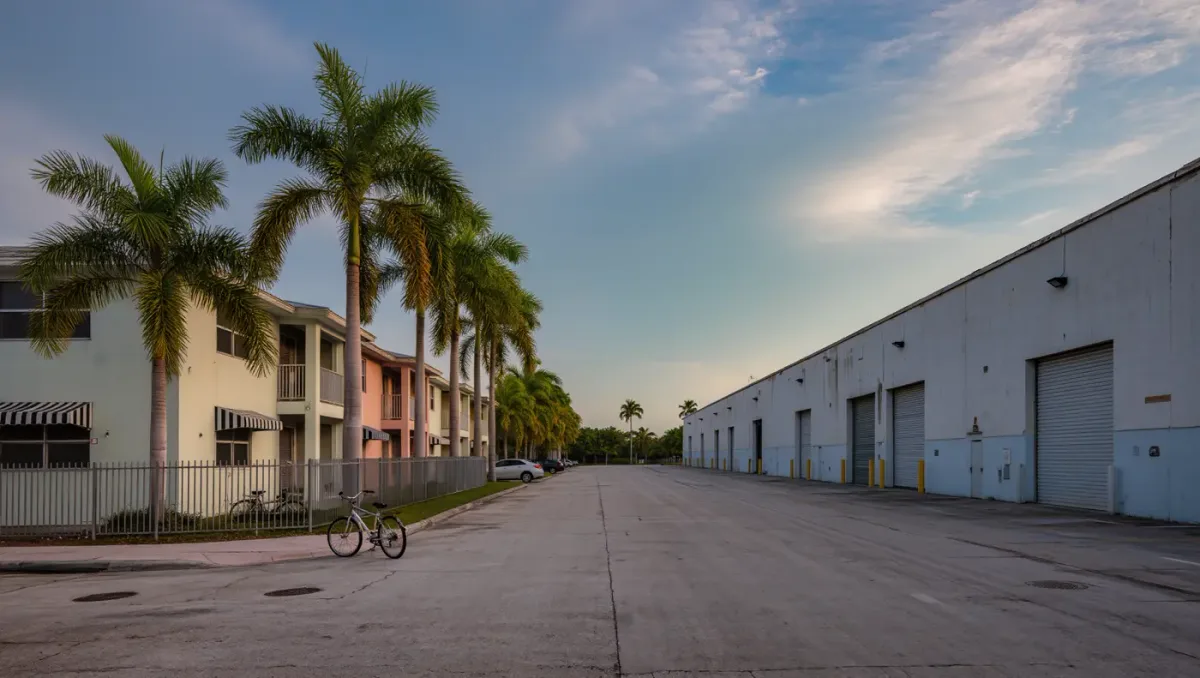
Little River sits north of Little Haiti and south of El Portal, roughly between I-95 and Biscayne Bay, and as of late 2025 its typical asking rent runs roughly $2,200 to $2,700 for a one-bedroom, per Zillow's neighborhood-level figures for November 2025. If you are weighing a move here, the short version is this: you get central location and older housing stock at prices below nearby MiMo and the Upper East Side, in exchange for blocks that still change character street by street.
This guide covers where the lines actually run, what you can expect to pay by housing type, what the commute looks like, and what has changed as warehouses along the river become studios and offices.
Where exactly is Little River?
Little River is generally bounded by NW 79th Street on the south, the Miami city limits near NW 87th Street and the village of El Portal on the north, I-95 on the west, and the Florida East Coast railway corridor east of Biscayne Boulevard, with the Little River itself cutting through the district's eastern half toward the bay. Some maps pull the eastern edge to Biscayne Boulevard; others include the industrial pockets along the river.
The confusion is understandable. Realtor listings have stretched the name onto streets that are formally part of Little Haiti or the Upper East Side historic district. A practical check: if you are east of I-95, between 79th Street and the El Portal line, you are in Little River as most residents and Miami-Dade planning maps use the term.
What does rent actually cost here?
One-bedroom units mostly advertised between roughly $2,000 and $2,700 a month as of November 2025, per Zillow's neighborhood data, with studios starting closer to $1,500 and two-bedrooms commonly listed from about $2,800 to $3,600. Single-family homes and duplexes, which make up much of the western blocks, rent widely by condition; dated three-bedroom houses have appeared in the $3,000s, remodeled ones higher.
The spread matters more than the midpoint here. Because the housing stock is older — much of it built from the 1940s through the 1970s — two apartments three blocks apart can differ by $500 for the same floor plan. Walk the block at the time you would normally come home, and ask what the electric bill runs on a summer month; older buildings with window units or weak insulation can add $150 or more to a July bill compared to a sealed newer build.
| Housing type | Typical range, Nov 2025 (per Zillow) |
|---|---|
| Studio | ~$1,500–$1,900 |
| 1-bedroom | ~$2,000–$2,700 |
| 2-bedroom | ~$2,800–$3,600 |
| Single-family house, 3 bed | ~$3,000–$4,500 by condition |
Who lives here, and what does the census say?
The area is one of Miami-Dade's most diverse edges: Census Bureau ACS 2023 five-year estimates for the surrounding ZIPs show a population mix with large Black and Hispanic shares and a median household income well below the county median, alongside a growing cohort of younger arrivals drawn by studio space. Renter occupancy is high across the neighborhood's multifamily blocks.
For your purposes, the census detail that matters is tenure and household size: a heavily renter area with many long-tenured households means landlord turnover is slower and off-street deals exist, but it also means fewer turnkey amenities. You are renting into a lived-in neighborhood, not a managed community with a leasing office.
How is the commute?
Little River is about 15 to 25 minutes by car to Downtown Miami in normal traffic and 20 to 35 to Miami Beach across the Julia Tuttle or via 79th Street, per typical Miami-Dade travel patterns as of 2025. The 79th Street Causeway puts Haulover and North Beach within roughly 20 minutes outside of rush hour.
Transit requires planning. Metrobus routes run along Biscayne Boulevard, NW 7th Avenue, and 79th Street, and the nearest Metrorail stations are at Northside and Dr. Martin Luther King Jr. Plaza, each a bus transfer away. Bike lanes thin out north of 79th Street, where cyclists share arterial roads. If you work Downtown and drive, this is an easy location; if you are car-free, test the exact bus trip to your workplace before signing a lease.
What changed: the warehouse-to-studio wave
Since around 2021, low-slung warehouses along NW 72nd to 79th Streets and the river's industrial spine have been converting into artist studios, small offices, and event space, with several hospitality openings along NW 2nd Avenue and Biscayne. The change has raised foot traffic on formerly empty blocks and, per local reporting through 2025, has begun showing up in asking rents on commercial corridors first, residential second.
What this means for you depends on which side of the river you rent on. East of the FEC tracks, expect faster change, new coffee and food options, and quicker rent growth. West of I-95's shadow toward 7th Avenue, the neighborhood remains quieter and cheaper, with more of the small duplex and triplex stock that keeps Little River's residential rents below the Miami median.
Is Little River safe?
Crime in Little River is uneven block to block and generally higher than the Miami-Dade suburban average, per Miami-Dade and City of Miami crime-mapping data reviewed for 2025, with auto-related and residential burglary reports concentrated on the dimmer interior streets. Well-trafficked corridors along Biscayne, the MiMo edge, and the newer studio blocks read very differently after dark than some interior streets.
Do the same diligence you would anywhere in Miami's urban core: visit at 9 p.m., not just 2 p.m.; check whether the building has gated parking and exterior lighting; and ask current tenants how the block feels on a weeknight. Avoid a blanket yes or no — the honest answer is that two blocks make a large difference here.
What should you check before signing a lease?
- Flood zone and insurance pass-through: parts of the neighborhood near the river and bay sit in FEMA flood zones; ask whether your building carries flood coverage and what happens to your costs after a rate change.
- Building age systems: for pre-1980 buildings, ask when the roof and electrical were last updated.
- Exact boundaries: confirm the address really is Little River and not an adjacent ZIP being marketed with the name.
- Commute test ride: do the actual door-to-door trip at your normal hour once before committing.
Little River's trade is straightforward. You trade some polish for location and price, and you watch change happen block by block. If the November 2025 ranges hold into 2026, it remains one of the few central Miami neighborhoods where a one-bedroom under $2,500 is still a realistic target.