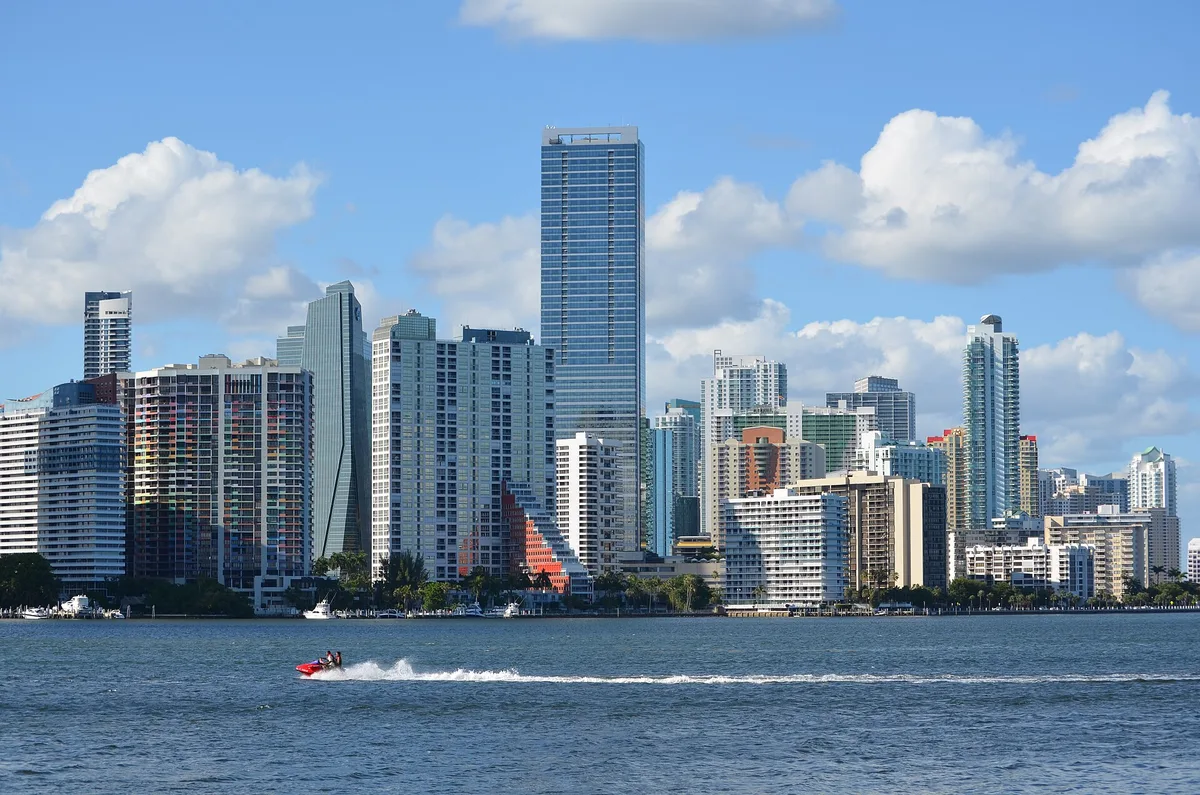
The skyline south of the Miami River stopped being a pure office address years ago. Brickell now stacks apartments over banks, with groceries, gyms, and dog runs inside the tower bases. Newcomers comparing neighborhoods keep asking the same two things: who lives there, and what rent actually buys.
Short answer: Brickell Miami held about 40,000 residents in 2024, per Wikipedia's profile, and it ranks as the city's densest neighborhood. Rent sits far above the citywide norm. Zumper's data, updated November 16, 2025, put the neighborhood median at $4,100, about 114 percent above the national median. Readers following this should also see Miami Shores vs. North Miami: where the rent math actually lands.
Both claims trace to primary pages: the neighborhood profile on Wikipedia and the Brickell rent research page from Zumper, captured in the Internet Archive. The sections below map the boundaries, the residents, the rent table, and the history behind the towers.
Where does Brickell start and stop?
The lines are precise. Brickell lies east of Interstate 95 and runs to Biscayne Bay, with the Miami River on the north edge and SW 26th Road at the Rickenbacker Causeway on the south, per Wikipedia's geography section. Broadway, also signed Southwest 15th Road, splits the financial blocks from the mostly residential streets to the south. We covered a connected angle in Little River: where the lines are, what rent runs, and what changed.
That footprint matters when listings stretch the name. A unit marketed as Brickell but sitting west of the interstate or across the river belongs to a different neighborhood. Holding listings to the map keeps rent comparisons honest.
Who lives in Brickell now?
The 2024 estimate runs about 40,000 residents, per Wikipedia, and the neighborhood carries the densest population in Miami. The economy is financial at its core. The profile describes Brickell as the financial district of Miami and of the wider South Florida region.
The mix has widened as the tower stock changed. Office towers dominated through the 1980s commercial boom, while residential high-rises spread through lower Brickell south of Broadway. Wikipedia's history section records the shift from Millionaire's Row estates to a walkable residential community with work and entertainment in one grid. The profile calls the result a dense, urban, residential and commercial neighborhood, and the resident base now stretches well past banking.
What does rent buy in Brickell right now?
The rent table is steep. Zumper's page for Brickell, stamped November 16, 2025, listed a median of $4,100 across all sizes, 114 percent above the national median. Studios averaged $2,650, one-bedrooms $3,395, and two-bedrooms $4,700, per the same table. Prices move, so treat the figures as a snapshot rather than a quote.
Context helps when the sticker shocks. The same November 2025 table placed the closest rivals well below the Brickell line, and the gap runs from roughly $600 to $1,100 a month:
- Brickell: $4,100 median across all sizes, 114 percent above the national figure.
- Downtown Miami: $3,504 median, per the same Zumper table.
- Coral Way: $2,975 median, the nearest value comparison on the list.
Condos averaged $4,150 against $4,000 for apartments, per the same page. Houses sat higher still at $4,200, though single-family stock barely exists inside the grid.
How did mansions become towers?
The land started as estate territory. Mansions along Brickell Avenue formed Miami's Millionaire's Row in the early twentieth century, per the profile, and office towers, hotels, and apartments began replacing them in the 1970s.
Mary Brickell Village opened in 2006 as the neighborhood's entertainment center, per the same source. Since then development has filled the blocks from Brickell Avenue west to the interstate, with the Metrorail line and the expanding Underline park at the center of the routine.
Conclusion: who the neighborhood fits in 2026
Brickell Miami packs about 40,000 people into a dense bayfront grid, per the 2024 estimate, and the price of that convenience shows in the $4,100 median from November 2025 data. The boundaries run from Interstate 95 to the bay and from the Miami River to the Rickenbacker. A budget near $3,400 matched the average one-bedroom in that table, and every figure moves with the market.