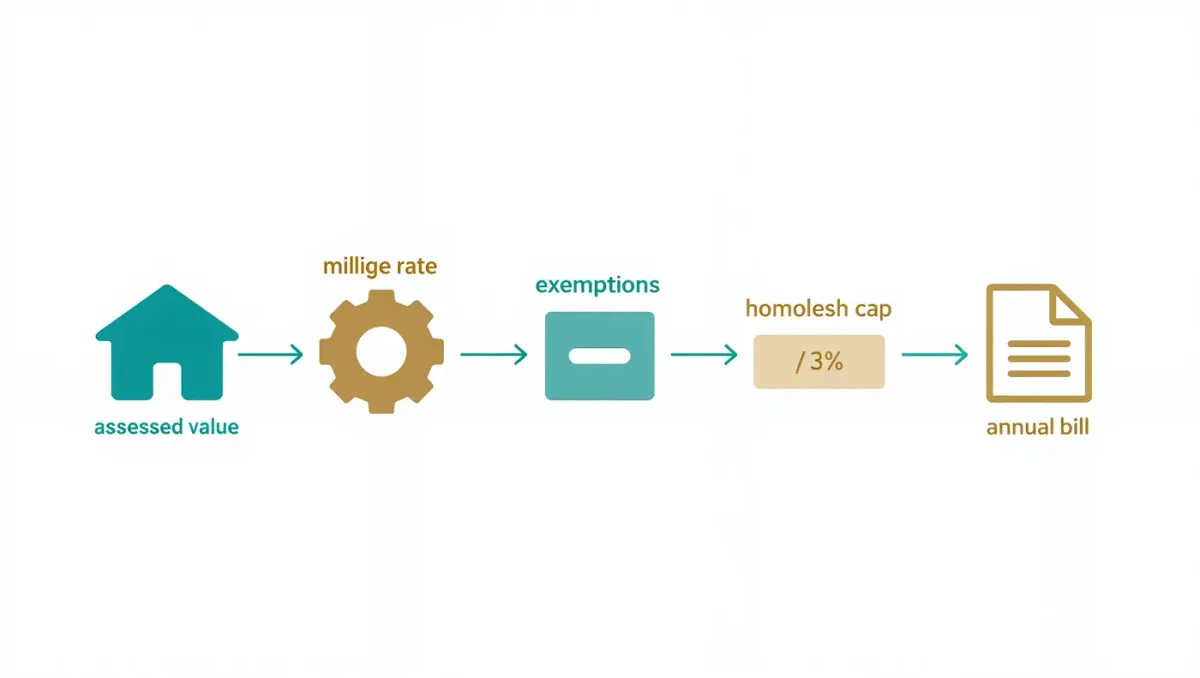
Your Miami-Dade property tax bill is simply your property's taxable value multiplied by the combined millage rate of every taxing authority on your ballot area, then reduced by exemptions — and because combined rates commonly run around 19 to 22 mills in much of Miami-Dade, per the Miami-Dade Property Appraiser's published millage data as of 2025, each $100,000 of taxable value means roughly $1,900 to $2,200 per year before exemptions. The bill has three moving parts: the assessment, the rate, and the exemptions, and each moves differently.
Miami In News publishes information, not financial or tax advice. This is a structural explainer; for your specific bill, use the county's own records and a tax professional where needed.
Who sets the value on your tax bill?
The Miami-Dade Property Appraiser, an elected county office, sets a market value for every parcel each year as of January 1, per Florida property-tax law. That value is not your purchase price and not your listing price — it is the office's estimate of market value, and after you qualify for homestead, a separate assessed value takes over, capped by the Save Our Homes rule. Every August, property owners receive a TRIM notice — the Truth in Millage statement — showing the proposed value, the proposed rates from each taxing authority, and the dates of the public budget hearings where those rates are discussed.
How do the homestead exemption and caps work?
Florida's homestead exemption removes up to $50,000 of assessed value from taxation for a permanent resident's primary home — the first $25,000 applies to all taxing authorities and the second $25,000 applies only to non-school taxes, per the Florida Department of Revenue as of 2025. Two caps then limit growth:
- Save Our Homes (homesteaded properties): the assessed value cannot rise more than 3 percent per year, no matter what the market does. Longtime owners can carry a large gap between market and assessed value — a gap that resets toward market value when the property sells.
- Non-homestead 10 percent cap: second homes, condos, and commercial property are capped at 10 percent annual assessment growth, per the 2008 state constitutional amendment still in force as of 2025.
This is the mechanism behind the familiar Miami surprise: buyers pay tax on a value that then steps up to near their purchase price, while the seller next door paid on a decade-capped value. Budget your second year of ownership on your own price, not the seller's old bill.
| Bill component | Who controls it | How it moves |
|---|---|---|
| Market value | Property Appraiser | Reassessed annually as of January 1 |
| Assessed value cap | State constitution/statute | 3% (homestead) or 10% (non-homestead) per year |
| Millage rates | County, school board, cities, special districts | Voted at public budget hearings each September |
| Exemptions | State law; you must apply | Fixed amounts; homestead requires filing by March 1 |
| Non-ad valorem assessments | Special districts, municipalities | Flat fees on the same bill (solid waste, stormwater, CDD) |
What are millage rates and why do they differ by city?
A mill is $1 of tax per $1,000 of taxable value. Your bill stacks separate millages: countywide, school board, your municipality if you live in one, and special districts — water management, fire, hospital districts. Per Miami-Dade's published rate sheets as of 2025, total combined millage in the county commonly falls in the high teens to low twenties, and two identical houses across a municipal line can carry meaningfully different totals because city millage and municipal service assessments differ. When comparing homes in different Miami-Dade cities, pull each parcel's actual tax bill from county records rather than averaging.
When are Miami-Dade property taxes due?
The calendar is fixed by state law, per the Florida Department of Revenue as of 2025: bills are mailed on or around November 1; taxes are due by March 31 of the following year; and early-payment discounts phase down — 4 percent in November, 3 in December, 2 in January, 1 in February. If you have a mortgage, your servicer typically collects monthly through escrow and pays on your behalf; without a mortgage, the November payment earns the full discount. Missing the March deadline triggers delinquency and, eventually, a tax-certificate process — not a bill to run past.
Can you appeal your assessment?
Yes, twice. First informally with the Property Appraiser's office, which can adjust errors in property characteristics. Then formally through the Value Adjustment Board, an independent county body; per Miami-Dade VAB procedures as of 2025, petitions must be filed within 25 days after the TRIM notice is mailed — a deadline that lands in September, which is why the August TRIM notice deserves same-week attention. Winning an appeal lowers the assessment; it does not change millage rates. Evidence that works: recent closed sales of comparable properties, appraisal reports, and documentation of condition problems the appraiser's data misses.
What else is on the bill besides tax?
Non-ad valorem assessments — flat charges for services such as solid waste, stormwater, and special district levies — ride on the same bill and are unaffected by exemptions or appeals. Per county billing practices as of 2025, these can add hundreds of dollars per year, so when you estimate a budget from a neighbor's bill, separate the ad valorem line from the flat fees.
Figures and dates reflect Miami-Dade and Florida tax law and published rates as of 2025. Millages and values change annually; verify current numbers on the county's official records before relying on them.
Frequently asked questions
How much is property tax in Miami-Dade?
As of 2025 published millage data, combined rates commonly run about 19 to 22 mills, so roughly $1,900 to $2,200 per year per $100,000 of taxable value before exemptions. Your city, exemptions, and non-ad valorem fees move the total.
Why did my taxes jump after I bought my Miami home?
The Save Our Homes cap reset. You are taxed on a value stepping up toward your purchase price, not the seller's capped assessed value. Budget the second year from your own price, plus current millage minus exemptions.
When is the deadline to file for homestead exemption in Florida?
March 1 of the year you claim it, per Florida law as of 2025. File with the Miami-Dade Property Appraiser once you occupy the home as your permanent residence; the exemption renews automatically as long as you qualify.
What is the TRIM notice?
The August Truth in Millage notice showing your proposed value and each taxing authority's proposed rate, with hearing dates and the Value Adjustment Board petition window — 25 days from mailing, per Miami-Dade procedures as of 2025.