With 30-year mortgage rates holding in the 6 to 7 percent range through late 2025, per Freddie Mac's weekly survey as of December 2025, renting in Miami remains cheaper month to month in most neighborhoods, and buying starts to win mainly when you plan to stay five or more years. The break-even is not a slogan — it is a computation of rate, insurance, taxes, and what your down payment could otherwise earn.
The worked examples below use round, clearly labeled assumptions so you can rerun the math with your own numbers; they are not a recommendation to buy or to rent.
What does the monthly math actually look like right now?
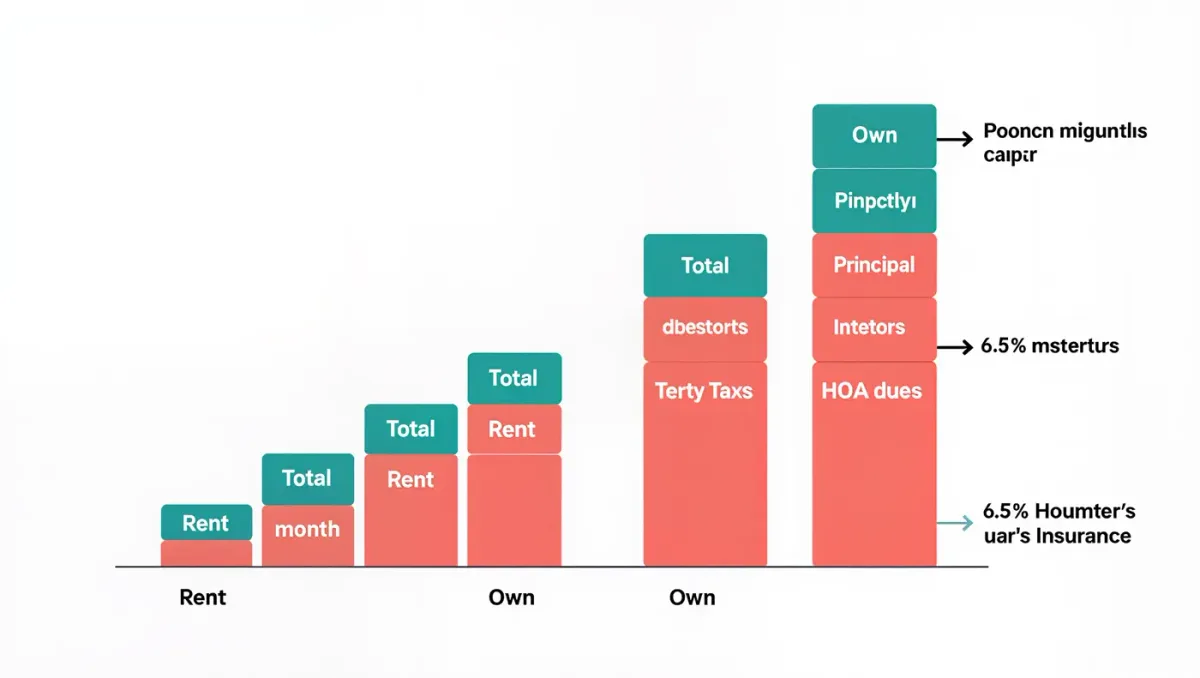
Take a plausible mid-market example as of late 2025: a $450,000 condo in Miami-Dade with 20 percent down — $90,000 — and a $360,000 loan at 6.5 percent for 30 years. Principal and interest runs about $2,275 per month. Add Miami-Dade property taxes at roughly the county's effective range of 1.8 to 2.2 percent of assessed value per the Miami-Dade Property Appraiser's published millage data as of 2025 (call it $700 to $850 monthly before any homestead cap), condo association dues that commonly run $400 to $900 for buildings with full amenities, and an HO-6 insurance share. Total ownership cost lands near $3,600 to $4,200 monthly.
A comparable two-bedroom rental in much of Miami-Dade was asking in the neighborhood of $2,800 to $3,500 per month as of late 2025, per major listing-platform market reports. Renting usually wins the raw monthly comparison — the question is what buying buys you.
Where does the down payment go if you don't buy?
This is the part most comparisons skip. Your $90,000 down payment, in a 4 to 5 percent money-market or Treasury yield environment as of late 2025, earns roughly $300 to $375 per month. That income is a real cost of buying — you give it up — though owning builds equity instead. Offsetting that, ownership carries costs renters never see: maintenance reserves, special assessments, and closing costs of roughly 2 to 5 percent, paid at purchase and again at sale.
| Monthly item (example, $450K condo, 20% down, 6.5%) | Owner | Renter |
|---|---|---|
| Principal and interest | ~$2,275 | — |
| Property taxes (pre-homestead estimate) | ~$700–$850 | — (in rent) |
| HOA dues | ~$400–$900 | — (in rent) |
| HO-6 insurance share | ~$30–$100 | ~$20–$40 (renters policy) |
| Rent, comparable 2BR | — | ~$2,800–$3,500 |
| Foregone yield on $90K down payment | ~$300–$375 cost | ~$300–$375 income |
How many years until buying breaks even?
At the example's numbers, buying costs roughly $600 to $1,200 more per month than renting a comparable unit before equity is counted. Equity builds slowly in the early years of a 6.5 percent loan — about $400 to $450 of the first year's payments is principal, per standard amortization — so year one, ownership is clearly behind. The case improves with home-price appreciation, which no one can predict; per the trade-off structure, the honest framing is that a buyer locking a 6.5 percent rate needs either sustained appreciation or a refinance to rates meaningfully lower to beat renting over a short hold.
Most housing-economics break-even analyses, including long-running work from Zillow's research desk, put the typical U.S. break-even in the two-to-four-year band when rates are moderate — Miami's higher insurance, taxes, and dues push that band toward its upper end as of 2025 estimates. Under roughly four to five years, renting usually wins here; beyond seven to ten, ownership history generally favors buyers who held through cycles.
What would have to change for the math to flip?
Three levers, in order of impact:
- The rate. Every half-point drop on a $360,000 loan cuts about $115 from the monthly payment. A refinance to 5.5 percent on the example loan saves roughly $230 monthly, per standard amortization.
- The homestead cap. Florida's Save Our Homes cap, per the Florida Department of Revenue as of 2025, limits assessed-value growth on a homestead to 3 percent per year, so the tax line flattens after your first years of ownership — renters never get this benefit.
- Rent growth. If Miami rents resume climbing, the renter's cost rises while a fixed-rate owner's payment does not. Listing-platform reports as of late 2025 showed Miami rents roughly flat to slightly softer than their 2022–2023 peaks, which is what keeps renting attractive today.
Does the math differ by neighborhood?
Sharply. The ownership premium is smallest where price-to-rent ratios are low. As of late 2025 listing data, per major listing-platform market reports: in Hialeah or parts of Kendall, a modest single-family home's total ownership cost can come within a few hundred dollars of renting a similar house. In Brickell or Miami Beach, where condo dues and insurance load on top of high prices, ownership often costs $1,500 or more per month above the rent of a comparable unit. Coastal flood-zone premiums widen the gap further.
What should a first-time buyer do with this math?
Run your own numbers with three inputs — your target purchase price, the true monthly cost including dues, insurance, and taxes, and how many years you realistically expect to stay. Per HUD guidance as of 2025, housing counseling agencies approved by the federal government offer free or low-cost help working through affordability, including Florida-specific costs. If your stay is short, the honest answer at current rates is that renting and investing the difference remains a defensible strategy, not a failure.
All figures are labeled estimates as of December 2025 and January 2026. Rates, rents, and insurance premiums change; rerun the math before you act.
Frequently asked questions
Is it cheaper to rent or buy in Miami in 2026?
Per late-2025 listing data and standard amortization at 6 to 7 percent rates, renting is cheaper month to month for comparable units in most Miami neighborhoods, often by $600 to $1,200 monthly. Buying wins on total wealth in longer holds, particularly if rates fall or the homestead cap phases in.
How much down payment do I need to buy in Miami?
Conventional loans allow as little as 3 to 5 percent down, and FHA loans 3.5 percent, though lower down payments add mortgage insurance and shrink nothing about dues, taxes, or insurance. The 20 percent figure in this article's example is illustrative, not a requirement.
At what mortgage rate does buying beat renting in Miami?
There is no single threshold, but as of late 2025 estimates the ownership premium narrows meaningfully below roughly 5.5 to 6 percent for mid-market units. The larger levers are how long you stay and whether the building's dues and insurance are stable.
Does the Florida homestead cap help buyers right away?
Partially. Per the Florida Department of Revenue as of 2025, the 3 percent assessment cap applies to your homesteaded property's assessed value over time; your first tax bill resets toward market value after purchase, and the cap's protection accumulates in the years you hold.