An arepa in Miami costs roughly $4 to $9 as of early 2026, and the style on your plate tells you where you are: griddled flat Colombian arepas dominate in Colombian pockets, while the stuffed, pillow-soft Venezuelan versions rule in Doral and the county's Venezuelan corridors. Both are ground-maize cakes, and both are cheap, filling food. Here is how to tell them apart and where to find each.
Miami may be the best arepa city in the United States, which makes the menu confusion worse — Venezuelan and Colombian traditions share a name but not a dish. This guide separates the two styles, walks through the fillings worth knowing by name, maps the neighborhoods, and prices the whole thing out. Prices are typical ranges, subject to change.
What is the difference between Venezuelan and Colombian arepas?
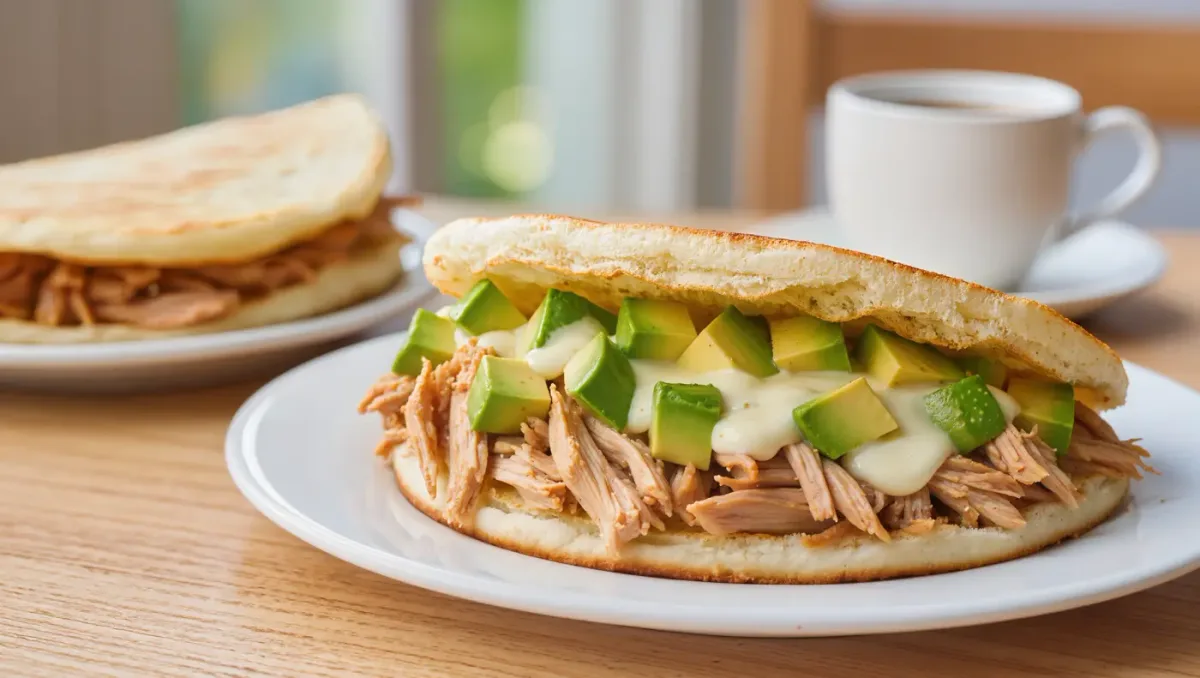
The same name covers two different foods. A Colombian arepa is usually thin and flat — a griddled or grilled cake of white cornmeal, often split and buttered, topped or sandwiched with cheese. It is a side or a breakfast base as much as a meal. A Venezuelan arepa is thicker, split like a pita, and stuffed generously with fillings; it is a full meal you eat with both hands. Venezuelan arepas get names for each filling combination, which is why Venezuelan menus read like a sandwich board and Colombian menus read like a short list. Neither is better — but ordering a Colombian arepa expecting a stuffed Venezuelan one, or the reverse, is the most common first-timer mistake in Miami.
Which arepa fillings should you know by name?
Venezuelan arepa menus are a vocabulary test, and knowing five names covers most of what Miami sells:
- La reina pepiada — the classic: shredded chicken and avocado salad, sometimes with mayonnaise. The default order and the best first arepa.
- Pelúa — shredded beef with melted yellow cheese. Hearty and hard to do badly.
- Dominó — black beans and white cheese. The vegetarian anchor of every Venezuelan menu.
- Catira — shredded chicken with yellow cheese, the poultry counterpart to the pelúa.
- Llanera or asada — grilled steak, cheese, tomato, sometimes a fried egg on top. The heavyweight option.
Colombian menus run simpler: plain arepa with butter, arepa con queso (cheese kneaded into the dough), arepa de huevo (the Cartagena-style arepa fried with a whole egg inside, a specialty you find at a handful of Miami counters), and arepa e' choclo, a sweeter yellow-corn version often served with cheese on top.
Where are Miami's arepa strongholds?
Arepa geography follows the county's Venezuelan and Colombian communities, and each zone has a slightly different specialty.
- Doral. The center of Venezuelan Miami. Areperas here range from bakery-style counters to sit-down rooms, menus run deepest, and quality competition keeps standards high. Expect the full vocabulary above and prices at the middle of the range.
- Kendall and West Kendall. A strong South American belt with family areperas and bakery counters, often paired with empanada menus and Sunday crowds. Prices among the most moderate in the county.
- North Miami and Biscayne Boulevard corridors. A mix of Venezuelan and Colombian counters serving the northern suburbs, plus late hours in spots near the working corridors.
- Hialeah. Better known for Cuban food but dotted with Colombian bakeries where flat arepas appear alongside pandebono and empanadas — the right zone for a Colombian-style breakfast arepa.
- Wynwood, Downtown, and Brickell. Fast-casual arepa bars aimed at office and nightlife crowds; the fillings hold up, the prices run toward the top of the range, and hours track the workday and the bar schedule.
How much should an arepa cost in Miami?
| Item | Typical price | Notes |
|---|---|---|
| Plain or cheese Colombian arepa | $3–$5 | Breakfast counter pricing, often with butter |
| Stuffed Venezuelan arepa | $6–$9 | Chicken and beef fillings at the higher end |
| Arepa combo with drink | $10–$14 | Usually arepa plus fresh juice or coffee |
| Arepa de huevo | $5–$7 | Specialty item, fewer counters make it |
Prices above are typical as of early 2026 and subject to change. The value logic is simple: a stuffed arepa is a full meal at fast-food money, and a $12 combo in Doral outperforms a $16 fast-casual bowl in Brickell on both quantity and flavor.
Are arepas gluten-free and how filling are they?
Traditional arepas are made from pre-cooked white or yellow cornmeal — masarepa — with no wheat, so they are naturally gluten-free; confirm with the counter, since kitchens vary on cross-contact and some modern versions blend flours. Filling-wise, one stuffed Venezuelan arepa with chicken or beef is a genuine lunch, roughly equivalent to a large sandwich, at 500 to 700 calories depending on cheese and avocado. A thin Colombian arepa with cheese runs lighter, closer to a side dish or a substantial toast. If you are watching sodium, note that cheese-heavy versions and llanera-style fillings carry the most.
What do you drink with an arepa?
The local answers are cheap and specific. Venezuelan areperas pour papelón con limon, a raw-cane-sugar and lime cooler, along with fresh juices like passion fruit and mango; Colombian bakeries lean toward coffee — a cafe con leche or a tinto, the small black coffee — plus Avena, a chilled oat drink that pairs well with a cheese arepa. Expect $2 to $5 for any of these at neighborhood counters as of early 2026. A stuffed arepa plus a papelón con limon is the standard Doral lunch order, and it lands inside the combo price band on the table above.
Can you make arepas at home cheaply?
Yes, and it is one of the easiest home-cooking projects in Miami. A bag of pre-cooked cornmeal costs a few dollars at any Latin market, mixes with water and salt in five minutes, and griddles in ten. The basic dough is two parts cornmeal to about two and a half parts warm water, rested briefly, patted into thick discs, and cooked on a lightly oiled pan until pale-gold spots form. Split and stuff with supermarket rotisserie chicken mashed with avocado for a DIY reina pepiada — total cost well under $3 per arepa. Many Miami kitchens keep the habit precisely because the homemade version is fast, cheap, and forgiving.