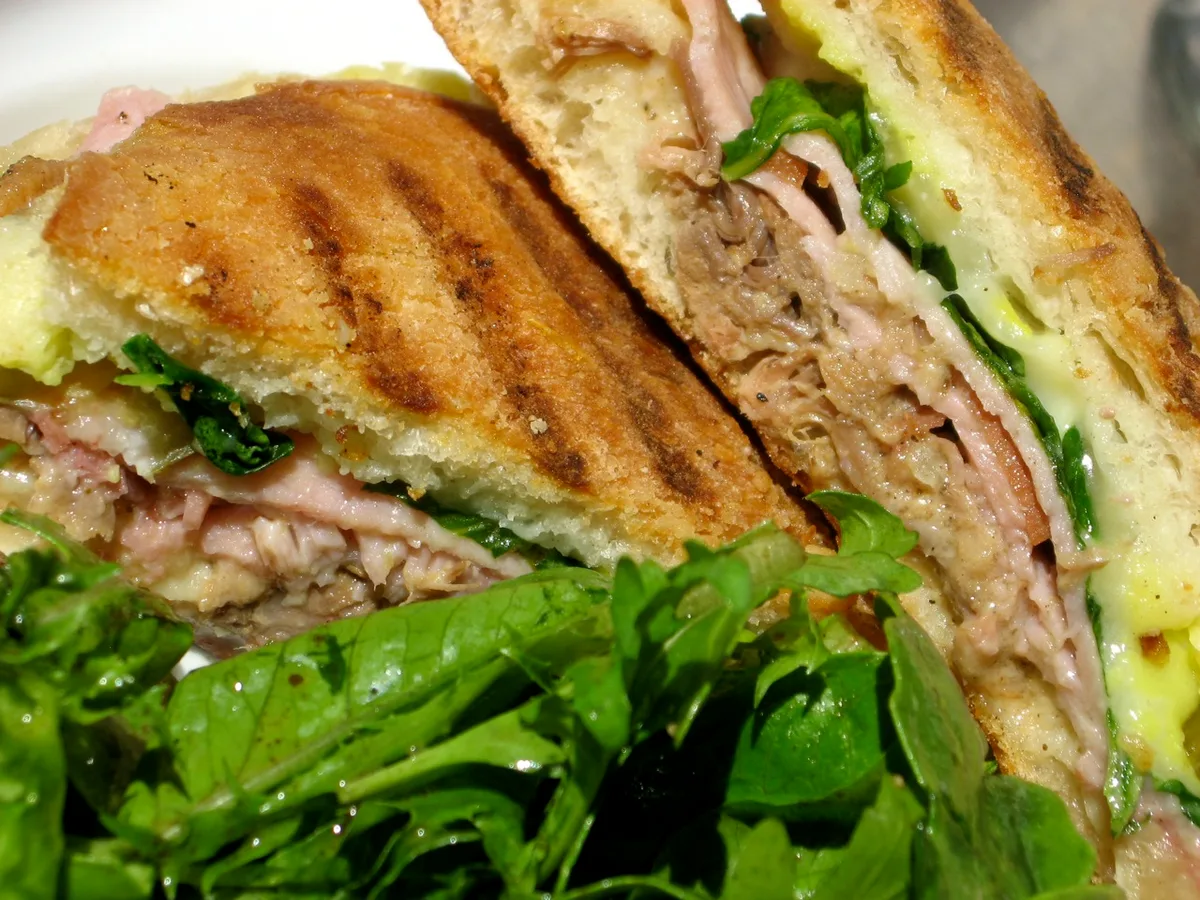
Miami argues about many things, and sandwiches sit high on the list. Two pressed favorites cause the most mix-ups. One is the Cuban sandwich. The other is the media noche, also written as medianoche. They look close to the same on a plate. They share most of their fillings. But they are not the same sandwich, and the bread is only the start of it.
Here is a simple guide to both. It covers the fillings, the bread, the press, and the city fight that comes along for the ride. Next time you order, you will know just what to ask for.
The Cuban Sandwich: The Classic Stack
The classic Cuban sandwich starts with Cuban bread. The loaf is cut into lengths of 8 to 12 inches and lightly buttered or brushed with olive oil, per the traditional recipe. The filling is a set stack. It holds yellow mustard, roast pork, glazed ham, salami, Swiss cheese, and thin dill pickles. That salami line matters. Tampa keeps it in. South Florida usually leaves it out.
Next comes the press. The sandwich goes on a flat grill called a plancha, which heats and squeezes it at the same time. It stays there until the crust turns crisp and the cheese starts to melt. Then it is cut in half, corner to corner.
The Media Noche: The Midnight Cousin
The name media noche means midnight in Spanish. That is no accident. The sandwich began as a late-night snack, most likely in the night clubs of Havana, according to its recorded history. A media noche holds the same fillings as a Cuban. The bread is what sets it apart. It comes on yellow egg bread, similar to challah, which is softer and sweeter than Cuban bread. The whole sandwich is also smaller than a full Cuban.
One Sandwich, Two Cities
The Cuban sandwich has deep roots. It likely grew out of cafes that fed Cuban workers in Tampa or Key West before the turn of the 20th century. Both towns were early Cuban immigrant communities, and the cigar trade sat at the center of daily life there. Historian Loy Glenn Westfall summed it up well. He said the sandwich was "born in Cuba and educated in Key West."
The story kept moving. The cigar trade shifted to Tampa in the mid-1880s, as the sandwich's history records, and workers in Ybor City turned it into a lunch staple. Cuban residents brought the food to Miami in large numbers after 1959. By the 1960s, it was common on Miami menus. The city rivalry never cooled either. In 2012, the Tampa City Council named the "Historic Tampa Cuban Sandwich" the official signature sandwich of that city.
Which One Should You Order?
Order a Cuban when you want the classic. It is long, crusty, and savory, with pickles and mustard cutting through the pork and ham. Order a media noche when you want something softer and a bit sweet. The egg bread makes it taste richer, and the smaller size makes it easier to hold. Neither one is the "right" pick. They are just two paths to the same flavors. For related coverage, see The essential guide to Miami's classic Cuban restaurants: old-school counters versus the new generation.
There is a third path too. Publix delis across Florida sell hot pressed Cuban sandwiches made to order, and the style ranks among the chain's bestsellers in its Florida stores. Purists may argue about that. Still, it is an easy way to taste the style close to home.
Conclusion
The media noche and the Cuban sandwich share one heart. Ham, roast pork, Swiss cheese, pickles, and mustard, all pressed until hot. The bread is what splits them. A Cuban uses firm Cuban bread in a longer loaf. A media noche uses soft, sweet yellow egg bread in a smaller one. One grew up in the working cafes of Tampa and Key West. The other grew up after dark in Havana. Both are Miami now. Try one of each this week and pick your own winner. We covered a connected angle in Lunch in Miami: what casual dining costs versus fine dining, line by line.