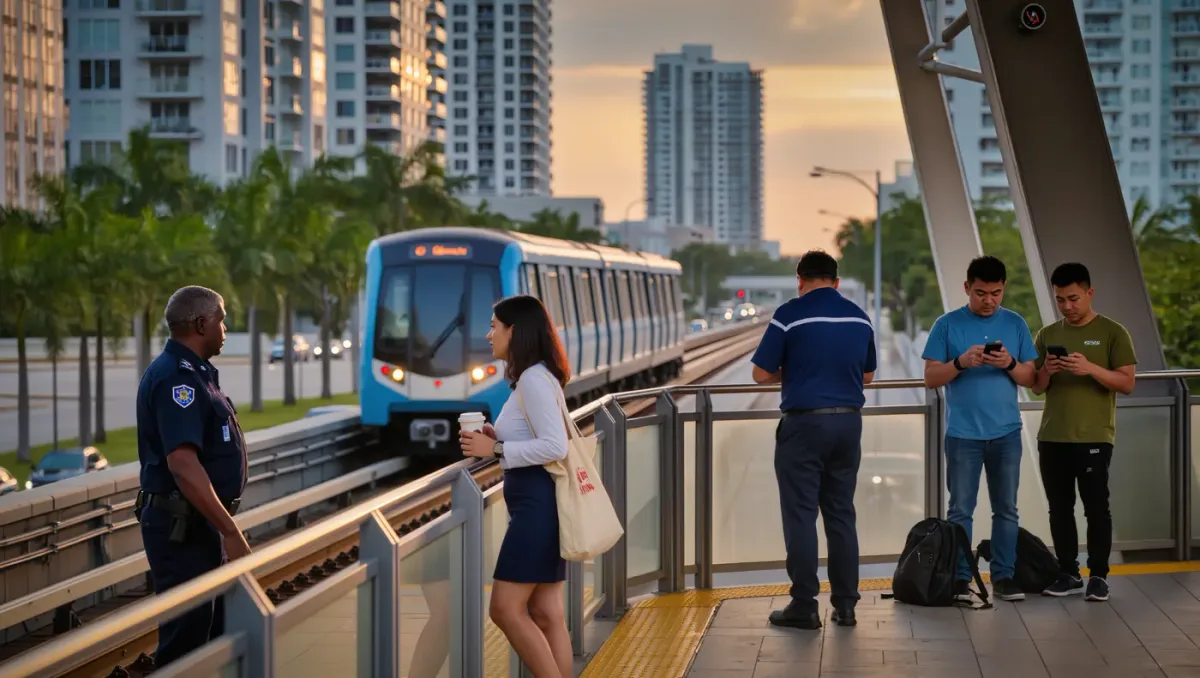
You can live in Miami without a car if you live along the Metrorail line or in a handful of dense districts, and you will struggle almost everywhere else. Metrorail runs roughly 25 elevated miles from northwest Miami-Dade down to Kendall, backed by the free downtown Metromover and a countywide bus grid, per Miami-Dade County transit data as of 2025. The honest math: Brickell, downtown, Edgewater, and station-adjacent suburbs are car-optional; most other addresses cost you 90 to 120 minutes a day in transit time.
This guide is for renters and new arrivals deciding whether to sign a lease with or without a parking spot. Miami In News publishes information, not advice; the figures below are estimates with their dates, and fares and schedules change, so verify current numbers with the county before you budget.
Which neighborhoods actually work without a car?
Car-free life holds up best where three things overlap: rail or frequent bus, walkable groceries, and density short enough that errands stay under 15 minutes on foot. Those conditions are real in Brickell, downtown and Park West, Edgewater, Wynwood, and parts of Little Havana near the bus trunk lines. In the suburbs, the exceptions are addresses within walking distance of a Metrorail station — South Miami, Dadeland, Coconut Grove's west side, and Coral Gables near the Douglas or University stations — per Miami-Dade County station-area profiles as of 2025.
What does transit cost compared with owning a car?
A monthly county transit pass ran about $112.50 as of 2025, per Miami-Dade Transit's published fare schedule, against several hundred dollars a month in insurance, parking, and fuel for a car. Add rideshare for beach trips and late nights, and most car-free residents we can model from typical usage spend $150 to $250 a month on mobility. The table below puts the two options on the same lines.
| Cost line | Car-free (transit plus rideshare) | Car ownership (used compact) |
|---|---|---|
| Fixed monthly | About $112.50 pass, per county fares as of 2025 | Insurance, registration, parking: roughly $250-$450 |
| Variable monthly | Rideshare $50-$150 depending on nightlife | Fuel and maintenance: roughly $150-$250 |
| Upfront | None | Down payment or purchase price |
| Time cost | 60-120 min/day outside rail corridors | 30-60 min/day in traffic plus parking hunts |
Rents do not always reward car-free living the way you would expect. Parking is often bundled into Miami leases, so a building with a garage may cost the same as a walk-up without one. What you are really buying in the car-free districts is time: a Brickell one-bedroom typically runs well above the countywide median asking rent, but it can eliminate a car payment, an insurance bill, and a daily highway commute in the same signature. Run both totals before you decide the cheaper zip code is cheaper, because in Miami-Dade it frequently is not once you add the second vehicle.
| Neighborhood | Rail or frequent bus | Walkable groceries | Car-free realistic? |
|---|---|---|---|
| Brickell | Metromover, Metrorail, bus trunk lines | Multiple full supermarkets in 10 min | Yes, easiest in the county |
| Downtown / Park West | Metromover, buses | Yes, with gaps between towers | Yes |
| Edgewater | Bus corridors on Biscayne Blvd | Yes along the boulevard | Yes, with longer beach trips by bus |
| Wynwood / Midtown | Buses; rail requires a transfer | Yes in the retail cores | Mostly yes |
| Coral Gables near stations | Metrorail at Douglas and University | Yes within the downtown core | Yes within about 10 min of a station |
| South Miami / Dadeland | Metrorail terminus area | Mall and big-box walkable | Yes if next to the station |
| Kendall, Doral, Hialeah east | Buses only, often 20-30 min headways | Sparse by design | No, budget for a car |
What about bikes and scooters?
A bicycle closes the biggest car-free gap in Miami, which is the two-mile radius around your home that buses cover slowly. Flat terrain helps, and several corridors have protected or shared lanes, though coverage is uneven and drivers are an honest part of the risk calculation. Electric scooters from the shared operators that hold city permits, per City of Miami program rules as of 2025, fill in for short hops. Budget $300 to $800 for a used commuter bike and a lock, and treat the combination of bike plus transit as the realistic standard setup here rather than walking alone.
How do you handle the airport, beaches, and big errands?
Miami International Airport sits directly on the Metrorail Orange Line, so the airport run is about 15 minutes from Brickell and 20 to 30 from the northern stations, per county schedules as of 2025 — one of the easiest in any large American city. Beach days work by bus or bike over the causeways in the morning and a rideshare back in the evening when buses thin out. Furniture and bulk runs are the one category where residents fall back on hourly car rentals or delivery fees, and it is worth pricing a $50-$90 rental day against what delivery services would charge for the same load.
How do you test a car-free address before you sign?
The lease decides the next twelve months, so run the address through a real weekday before you commit. One morning of fieldwork beats any app estimate.
- Ride the actual commute at 8:30 a.m. on a weekday, not a Sunday afternoon; note the door-to-door time.
- Walk to the nearest full grocery store; if it is more than 15 minutes on foot, you will be paying delivery fees weekly.
- Check the evening bus frequency after 9 p.m. — several Miami-Dade routes drop to 30-minute headways, per county schedules as of 2025.
- Price one weekend rideshare round trip to the beach and one to Miami International Airport; add both to your monthly budget twice.
- Confirm the building has secure bike storage if you plan to close the last-mile gap with a bicycle.
Where does car-free life break down?
Three errands reliably break the no-car plan: the beach before sunrise or after dark, big-box runs for furniture, and anything in western suburbs like Doral or Kendall that the rail never reaches. Summer is the fourth enemy — standing at a bus stop at 2 p.m. in July heat is a planning error, not a hardship story. Most long-term car-free residents solve this with a bike plus a part-time car rental a few times a year rather than full ownership.
Is a car-free move to Miami realistic for you?
If you rent in Brickell, downtown, Edgewater, or within a 10-minute walk of a Metrorail station, and your job is also on the spine, yes — and you will save roughly $3,000 to $5,000 a year against car ownership, based on the cost lines above as of 2025. If your work or family sits in the western suburbs, a cheap used car will cost you less than the hours you would lose. The neighborhood choice matters more than the willpower.
Quick answers
- Do I need a car in Brickell? No — groceries, gyms, restaurants, and offices sit within a few blocks, and the Metromover is free.
- Can I live in Miami Beach without a car? It works in South Beach and Mid-Beach for daily life; getting to the mainland relies on bus bridges over the causeways.