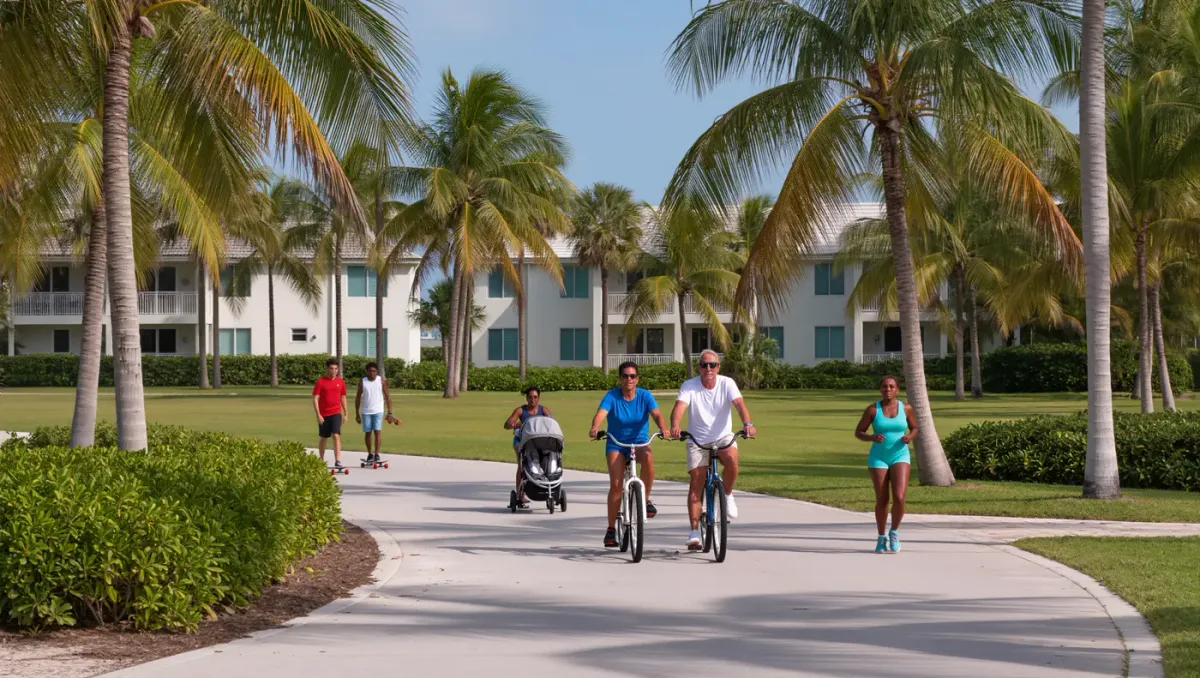
Key Biscayne is the island village off the Rickenbacker Causeway, and its cost of living runs roughly 40 to 70 percent above the Miami average across the major lines: typical one-bedroom rents listed around $3,300 to $4,300 a month as of February 2026, per Zillow neighborhood data, and a car crossing the causeway pays a toll in the $3 range each way, with resident discount programs available through the village. The premium buys beach access, one of Florida's lowest-crime communities, and a K-8 public school on the island.
Below, the major cost lines one by one — housing, transport, food and services, insurance and storm exposure — each with its source and date, so you can build your own budget.
What does housing cost on Key Biscayne?
Housing is the island's dominant line. As of February 2026, per Zillow neighborhood figures, typical listings ran roughly $3,300 to $4,300 for one-bedroom apartments, $4,500 to $6,500 for two-bedrooms, and $7,000 upward for houses and larger units; purchase prices per Census ACS 2023 context sit far above the county median, with the village's median household income among Florida's highest.
| Unit type | Typical rent range, Feb 2026 (per Zillow) |
|---|---|
| 1-bedroom | ~$3,300–$4,300 |
| 2-bedroom | ~$4,500–$6,500 |
| House / 3-bedroom+ | ~$7,000 and up |
Inventory is small and turns slowly — the island is almost entirely condominiums and a modest number of single-family streets, so comparable units are few and the market moves in single listings rather than trends. If a specific floor plan matters to you, expect to wait for it rather than choose among many.
What does the commute and the toll cost?
Every car trip to the mainland crosses the Rickenbacker Causeway, a tolled road whose per-car toll has sat in the $3 range each way in recent years, with discounted resident programs administered through the village and the tolling authority, per published rate schedules as of 2025. A daily commuter should budget roughly $120 to $150 a month in tolls before any resident discount, plus parking at the destination.
Drive times: Downtown Miami runs 20 to 30 minutes in normal traffic and the airport 30 to 40, per typical 2025 Miami-Dade patterns, with the causeway as the single fixed route in and out. Transit exists but is thin — Metrobus route B along the causeway connects to the Virginia Key stations area and downtown buses; most households keep at least one car, and many keep two. Cyclers get one of the county's best commuting routes: the causeway's bike path and the Bear Cut bridge lane are the island's de facto second road.
What do food and daily services cost?
The island carries one full-service supermarket and a small set of restaurants and cafes clustered in the Crandon Boulevard corridor, and its everyday prices run above mainland Miami levels for comparable baskets, per listed menu and shelf prices reviewed in late 2025. Many residents do their main grocery run off-island and use the village market for top-ups, which adds a mainland stop to the week but trims the grocery line noticeably.
Services follow the same pattern: a limited set of salons, gyms, and repair shops on-island means less price competition than in the city. Households that already pay mainland service providers typically keep them and absorb the trip; the alternative — island-only vendors — is convenient and priced accordingly. Childcare and after-school programs run through the village's community center, which is the island's best-value service line by a wide margin relative to private mainland equivalents.
What about insurance and storm exposure?
Key Biscayne is a barrier island with full coastal exposure, and that shows up in insurance more than in any mainland neighborhood of similar size: condominium associations carry master policies whose premiums have risen sharply with the Florida market, and per-unit pass-throughs appear in association dues, which on the island commonly run from the high hundreds of dollars monthly in older buildings, per association budget disclosures and Florida insurance-market reporting through 2025.
For renters this arrives indirectly — in rents that fund those dues — and directly if you insure your own contents, which is cheap relative to the master policy. For buyers, the diligence list is specific: the building's recertification status, its reserve study, its flood zone, and its master-policy renewal history. Ask for all four in writing; on this island the answers move your true monthly cost more than the listed rent or price does.
What do you get for the premium?
The returns are real and easy to list. Crandon Park and Bill Baggs Cape Florida State Park bracket the island with two of South Florida's best beaches; the village's public safety services are its own, and its crime rates sit among the lowest in Miami-Dade per 2025 department data; the K-8 public school sits a walk from most buildings; and the community center, tennis center, and greenway path system make car-free childhood practical in a way few Miami places match.
The Census ACS 2023 five-year estimates sketch who pays for that: a population with a large Latin American international household share, median household income well above the county figure, and high owner occupancy with a steady rental undercurrent of short- and medium-term relocations. The island's demographic stability is part of what you are buying.
Who does the math work for?
- Households of two or more sharing a two-bedroom split the housing line that makes the island hard for singles at $3,300-plus.
- Families prioritizing school, beaches, and safety over space often find the premium replaces other lines — second car, private activities, beach clubs.
- Remote workers who commute twice a week shrink the toll line and keep the lifestyle benefit.
- Anyone on a strict mainland-comparable budget will feel the gap monthly; the island rarely pencils as a cost-saving move.
Run your own lines against the February 2026 figures above and re-check toll and insurance numbers at their published sources — those two, more than rent, are where Key Biscayne's arithmetic has shifted most in recent years.