Hurricane preparedness in Miami comes down to three quiet jobs: a kit you build once, documents you copy once, and a plan your household agrees on once. Do them in May, before any storm watch, and the season becomes something you track instead of something that tracks you. The official Atlantic season runs from June 1 through November 30, though storms can form outside those dates, per NOAA's National Ocean Service.
It helps to know what you're actually preparing for. A storm becomes a hurricane when its sustained winds reach 74 mph; below that, it's a tropical storm at 39 mph or a tropical depression under it. The Atlantic basin averages about 12 named systems a year, and the National Hurricane Center tracks every one of them.
Preparation also buys you time, and time is the real currency of a storm week. If you want the room-by-room version for an apartment or a family, our hurricane season checklist for your apartment and family pairs well with this guide. Here, the focus is the household-level groundwork: the kit, the paperwork, and the plan.
What exactly are you preparing for?
A hurricane is a rotating low-pressure system with organized thunderstorms, and its damage potential rises with its category on the Saffir-Simpson scale, a 1-to-5 rating based on maximum sustained winds, according to NOAA. The higher the category, the greater the potential for property damage. That is the whole scale in a sentence: wind speed is the yardstick, and everything else follows.
Timing is less predictable than the scale suggests. The 2026 season made that point clearly: Hurricane Isaias became the season's first Atlantic hurricane on October 8, tying the record for the latest date of a season's first hurricane, a mark set in 1905, and it went on to peak as a Category 3 with 120 mph winds before landfall near Destin, Florida. Insured losses in the United States were expected to surpass $2 billion, per Wikipedia's account of the storm. The lesson for a household is simple: a late-starting season is still a season, and a calm May is not a forecast.
What goes in a hurricane kit that actually gets used?
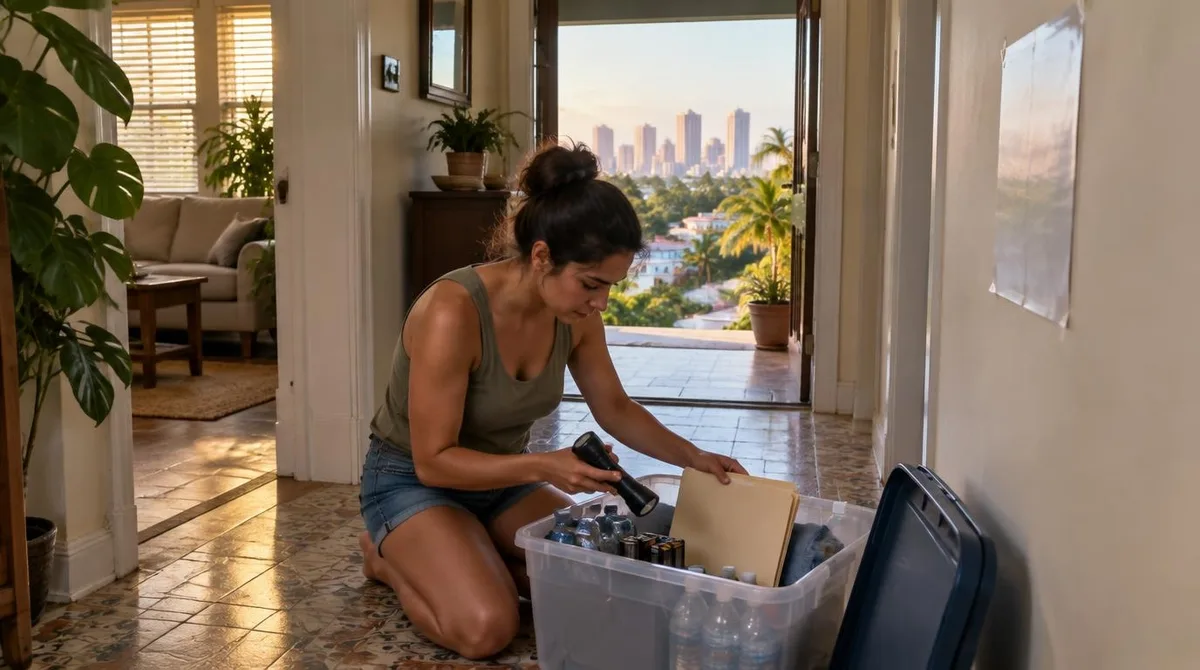
The honest answer is: the things you would otherwise fight a crowd for in the 48 hours before landfall. Water, shelf-stable food, a manual can opener, flashlights, batteries, a phone battery pack, a first-aid kit, and any prescription medications your household depends on. None of this is exotic, and none of it needs to be bought in one trip — a kit assembled across a few ordinary grocery runs in May costs less and stresses less than a panic cart in June. Readers following this should also see Life after 65 in Miami: senior living options and what each one costs.
Two additions separate a real kit from a symbolic one. The first is cash in small bills, because card readers and ATMs do not care about your emergency when the power is out. The second is a written list of what you own, room by room, which matters less during the storm than after it, when an insurance conversation begins.
Storage matters as much as contents. Keep the kit in one place everyone in the household can reach, in containers that close, off the floor if you live where water has ever come in. A kit you cannot find in the dark is decoration.
Which documents do you need, and where should they live?
Think in three layers. The first layer is identity and ownership: photo IDs, birth certificates, passports, leases or deeds, and insurance policies. The second layer is proof of what you have: the room-by-room inventory, plus photos or video of each room, which is the record an adjuster will ask about. The third layer is money and access: account numbers, a card, and the phone numbers of your insurer and your landlord or property manager.
Copy all of it twice. One set goes in a sealed, waterproof bag inside your kit or your go-bag. The other goes somewhere the storm cannot reach — a secure cloud folder or a person you trust outside Florida. Paper originals stay home in the driest interior spot you have, not in a garage or a ground-floor closet facing the weather side of the building.
One habit worth building: update the photo inventory every June 1, the same day you check the kit's batteries and food dates. Tie it to the season's start and you will never do it from memory.
What should a household plan actually decide?
A plan is a set of decisions made in advance, and there are only a few that matter. Decide, in writing, where your household goes if you leave, who you leave with, and what triggers the decision — a watch, an evacuation order for your zone, or a specific forecast. Decide how you will communicate if cell service is thin: an out-of-state contact everyone texts, checked in on a schedule. Decide what happens to pets, because a plan that assumes a pet will simply come along is not a plan.
For renters, the plan has one more line: know what your building does and what it does not. Ask your property manager, before June, about shutters or impact glass, generator coverage, and whether management communicates by email, app, or a lobby notice. The answers shape whether your plan is "stay in place" or "leave early."
Write the decisions on one page. A plan that lives in everyone's head is a plan only the most organized person in the house has.
How do you track a storm without drowning in noise?
Use official sources and one habit. The NOAA live hurricane tracker overlays current satellite imagery with National Hurricane Center data, and the NHC's own site, hurricanes.gov, is where forecast details live. Check once a day in a quiet season and twice a day when something is named. Social media is a fine place for local texture and a bad place for a forecast.
Learn the vocabulary once and it stops being scary. A watch means conditions are possible; a warning means they are expected. The cone is a track forecast, not a damage forecast, and a small cone says nothing about how wide the wind and rain reach.
What this means in practice: the storm you prepare for in May is rarely the storm that arrives, and the preparation is what carries over. Isaias in 2026 formed in early October and still produced evacuations across three Gulf states — proof that the calendar's quiet stretches are exactly when the kit and the plan earn their keep.
Where this leaves you
Three jobs, none of them urgent until they are: build the kit across a few ordinary shopping trips, copy the documents into two places, and write the household plan on one page. Finish them before the first storm watch and the rest of the season is watching and waiting, which is the version of hurricane season nobody dreads.
Miami households have plenty of other seasonal logistics to manage, from the summer heat to the first-30-days scramble covered in our moving-to-Miami checklist. Storm prep fits the same pattern: a fixed list, done early, checked once a year. More practical living guides live in our lifestyle section. This connects to our earlier piece, Miami summer heat: how to run a home, a budget, and a schedule through it.